Thai international Law Office Thailand
DUE DILIGENCE CONVEYANCE
Sale & Registration of Real Estate Wherever You Are
Not in Thailand? No worries, we can represent you by
INTERNATIONAL POWER OF ATTORNEY
Real Estate Lawyer Thailand
With the full guarantee of our law office known and listed by major European embassies.
Reasonable fees.
Property Due Diligence in Thailand
Legal Protection for Foreign Buyers (Pattaya, Bangkok and throughout Thailand)
Buying property in Thailand without proper legal due diligence can expose foreign buyers to significant and often irreversible risks.
Unlike many Western jurisdictions, Thailand does not rely on a notary system that automatically guarantees the legality of a transaction. For this reason, independent legal verification is essential before any payment or agreement.
We assist foreign clients mainly in Pattaya and, for significant matters, also in Bangkok and throughout Thailand.
What Is Property Due Diligence?
Property due diligence is the legal process of verifying that a property can be safely purchased and used without hidden legal issues.
It involves analyzing documents, ownership, and legal rights before completing a transaction.
What We Actually Verify
A proper due diligence process typically includes:
- verification of land title (Chanote, Nor Sor 3, etc.)
- confirmation of ownership and right to sell
- check for mortgages, liens or encumbrances
- review of building permits and legal compliance
- verification of access rights and utilities
- consistency between official documents and actual property
This process is essential to identify risks that are not visible to the buyer.
Common Problems We Identify
In many transactions, we detect issues such as:
- unclear or disputed ownership
- unregistered or ineffective agreements
- land with legal limitations or restrictions
- discrepancies between title and actual use
- hidden risks not disclosed by agents or sellers
These problems are more common than most buyers expect.
Real Cases (Anonymised)
Case 1 – Deposit Lost Before Legal Check
A foreign buyer agreed to purchase a house and paid a significant deposit based on information provided by an agent.
No legal due diligence was performed before payment.
Subsequent checks revealed that:
- the seller was not the registered owner
- the property could not be legally transferred
The deposit could not be recovered.
Case 2 – Land Not Transferable
A buyer entered into an agreement for land that appeared regular and properly documented.
However, due diligence revealed that:
- the land title carried limitations
- the property could not be legally transferred under the intended structure
Without verification, the buyer would have completed a transaction that could not be enforced.
Why Due Diligence Is Critical in Thailand
In Thailand:
- legal protection depends on proper documentation
- contracts alone may not provide sufficient security
- informal advice is often unreliable
Without proper verification, buyers may face:
- loss of investment
- legal disputes
- inability to transfer or use the property
Once a transaction is completed, correcting mistakes can be extremely difficult.
When to Request Due Diligence
Legal due diligence should always be carried out:
- before paying any deposit
- before signing reservation or sale agreements
- before entering leasehold or company structures
- before relying on real estate agents
Early verification is essential to avoid irreversible errors.
Pattaya and Bangkok: Practical Considerations
- Pattaya: high volume of foreign transactions, often fast-paced
- Bangkok: more structured but equally complex
In both locations, legal risks are significant without proper checks.
Legal Assistance for Property Due Diligence
We assist foreign clients with:
- full legal due diligence
- document verification and risk assessment
- contract review and drafting
- coordination with Land Office procedures
Our services are mainly based in Pattaya and, for significant matters, also in Bangkok and throughout Thailand.
Related Legal Services
Contact our lawyers in Thailand for legal assistance:
Email: info@thesociallawyers.com
Line ID: 0621278812
Tel: 0621278812 – 0926921844
His Grace the Property and His Excellence the....Chanot.
or.... give me the cat...I give you the pig... how to safely acquire a property in Thailand.
Please note. This article intends to provide useful and essential information in order to help and protect any foreigners should they ever wish to purchase a real-estate property in Thailand, but this article cannot be a substitute for the assistance of a competent lawyer.
In fact, before buying a real property, it is good practice and common sense to ask a qualified legal assistance to execute the due "due-diligence" and the conveyance. Here, more than anywhere else, due to the logical difficulties for foreigners to fully understand the Thai writing and the local regulations it is highly advisable to avoid the "do it yourself" but...
Let's start with the good news:
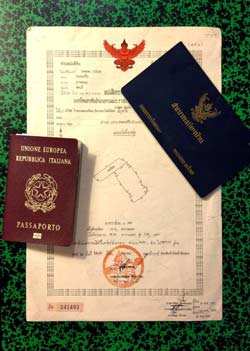
All real estate properties: land, houses, condominium units etc., in Thailand are registered at the pertinent "Land Office" which will deliver a beautiful, large document, the Title Deed, printed on light brown cardboard, a sort of official extra-large "monopoly's" card. On the back of the Title Deed there are clearly printed the names of all previous owners as it will also include the name of the new owner once the registration is completed. There are several kinds of Title Deed but only one will guarantee the full right of property and deserves the name of His Grace the "Chanot".
The Local (pertinent) Land Office will deliver it immediately to the new owner, as the transaction would have been properly registered.
Still nowadays in a super technological world, most of the transactions related to real estates in Thailand are executed following the ancient Thai proverb: "yeun meu, yeun muu", equivalent to the English "cash on the barrel" or translate literally into English "give me the cat and I give you the pig", as the payments are completed only when the buyer has the Chanot in his/her hands.
In the olden times, not so olden to be honest, the person holding the Chanot, was de facto the legitimate owner of the land. Just like in the game of Monopoly, with no need of further procedures.
All this seems, and partly is, extremely reassuring. Unfortunately, however, things are never so simple.
Red Alert...
First of all there is not just a single kind of title deed, but only one can, with legitimacy, be called "Chanot": the Nor Sor Si Jor. It is the only title that, once we have proceeded to a meticulous due diligence, would guarantee to the owner full rights over the property, as they say usque ad sidera usque ad inferos, with a few exceptions.
A foreigner should buy only properties registered on His Grace the Chanot disregarding the fact that, in many cases, the Thais still buy and sell properties, sometimes of very relevant value, without such a title deed and, in some cases, even lacking any titles at all. This is something that a foreigner should never-ever think about, even if reassured by a horde of family members or friends. I would say that the farthest a foreigner could dare to go is the "Nor Sor Sam", a younger brother of the Chanot that usually can follow the brilliant career of the elder and acquire the status of Chanot itself. The Nor Sor Sam is related to a plot of land of which borders with its neighbors have not been precisely defined yet by the Land Office. Simply put, it is not a full title deed, but it can be upgraded with a 30 day public notice before the sale to consent to the neighbors to raise objections as the sale of the land might be part of their plot of land.
But be careful, beyond the two noble brothers, there is a plethora of titles looking to foreign eyes exactly as His Excellency the Chanot, but assuring not rights at all, especially to foreign nationals. A blatant example is the So Bo Kho, a title that cannot be transferred or sold and that it only ensures the right to grow crops (which is forbidden to foreign nationals) with absolute ban on building.
Furthermore do not forget that a Chanot can be easily forged by expert scams.
Here then some practical advise to buying properties in Thailand with complete security
Before buying a property always:
1) Order a meticulous due diligence.
2) Ask for a copy of the Chanot and a copy of the ID of the previous owner .
3) If the previous owner is married, demand the spouse to come along and sign.
4) Check at the Land Department if the property is still registered with the name of the seller.
4) Demand to sign a proper sale-purchase contract drawn up by a trusted legal office, properly signed on any pages and by two witnesses, possibly resident in Thailand. (For further information read our article "His Majesty the Contract").
5) Pay only with traceable forms of payment, such as bank checks and bank transfers.
6) Remember that the real estate agents can not be held responsible for possible scams of the sellers. The due diligence is a burden that shall be the obligation of the buyer.
7) Seek legal assistance whether you wish to buy or to sell a property especially if the property is in the name of a company.
Dulcis in fundo... (at last but not at least ...)
Let's go back to the "good News". For a start the "Due Diligence" and the related conveyance practices are not expensive in Thailand. With the assistance of a competent lawyer, you can secure the property in your or your company's name in a matter of a few days if not a few hours.
The taxes on real estate properties are very reasonable, far cheaper than in the West. The transfer fee is only 2% of the estimated value, and the return in rental revenue can be gorgeous especially in a tourist town as Pattaya.
In other words...come, buy the home of your dreams and enjoy it, but be vigilant... at least as much as you would be in your own country!
 Due Diligence